VMware 3V0-25.25 Exam Dumps in PDF Format
Wiki Article
2026 Latest ExamcollectionPass 3V0-25.25 copyright and 3V0-25.25 copyright Free Share: https://drive.google.com/open?id=1bn7AGxooe3Cpi98Twg79HJaXgXlSei8P
The desktop practice test design is best for self-appraisal and decreases the possibilities of disappointment in the Advanced VMware Cloud Foundation 9.0 Networking (3V0-25.25) Exam. It is upheld by each window PC which assists clients with clearing the VMware 3V0-25.25 certification exam with passing marks.The web-based format can be gotten online without introducing the product for the VMware 3V0-25.25 Exam. The web-based practice test is upheld by every one of the working frameworks and programs which will be useful for Advanced VMware Cloud Foundation 9.0 Networking (3V0-25.25) exam preparation.
VMware 3V0-25.25 Exam Syllabus Topics:
| Topic | Details |
|---|---|
| Topic 1 |
|
| Topic 2 |
|
| Topic 3 |
|
| Topic 4 |
|
| Topic 5 |
|
Examinations 3V0-25.25 Actual Questions - Reliable 3V0-25.25 Study Guide
As we know, it is necessary to improve your capacity in work if you want to make achievements on the job or your career. At present, many office workers choose to buy our 3V0-25.25 study materials to enrich themselves. If you still do nothing, you will be fired sooner or later. God will help those who help themselves. Come to snap up our 3V0-25.25 Exam Guide to let yourself always be the most excellent and have a better life!
VMware Advanced VMware Cloud Foundation 9.0 Networking Sample Questions (Q54-Q59):
NEW QUESTION # 54
An administrator has been tasked with enabling OSPF as the routing protocol for a Tier-0 Gateway. Which two items must be configured to enable OSPF for a Tier-0 Gateway?
Mark two answers by clicking the two correct locations on the image. (Choose two.)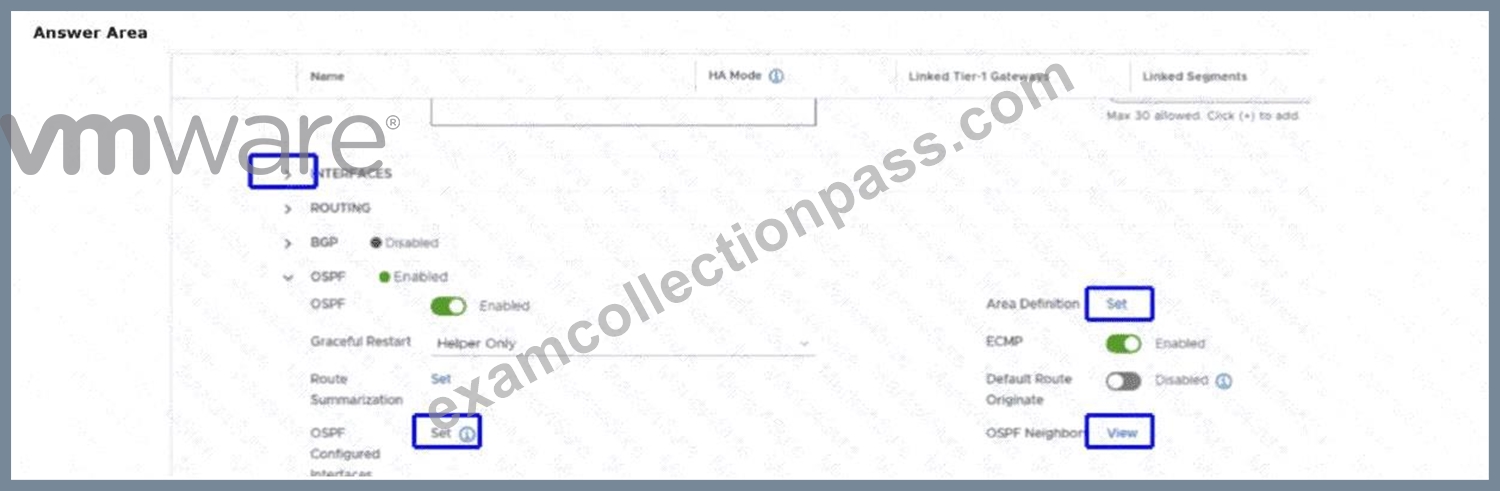
Answer:
Explanation: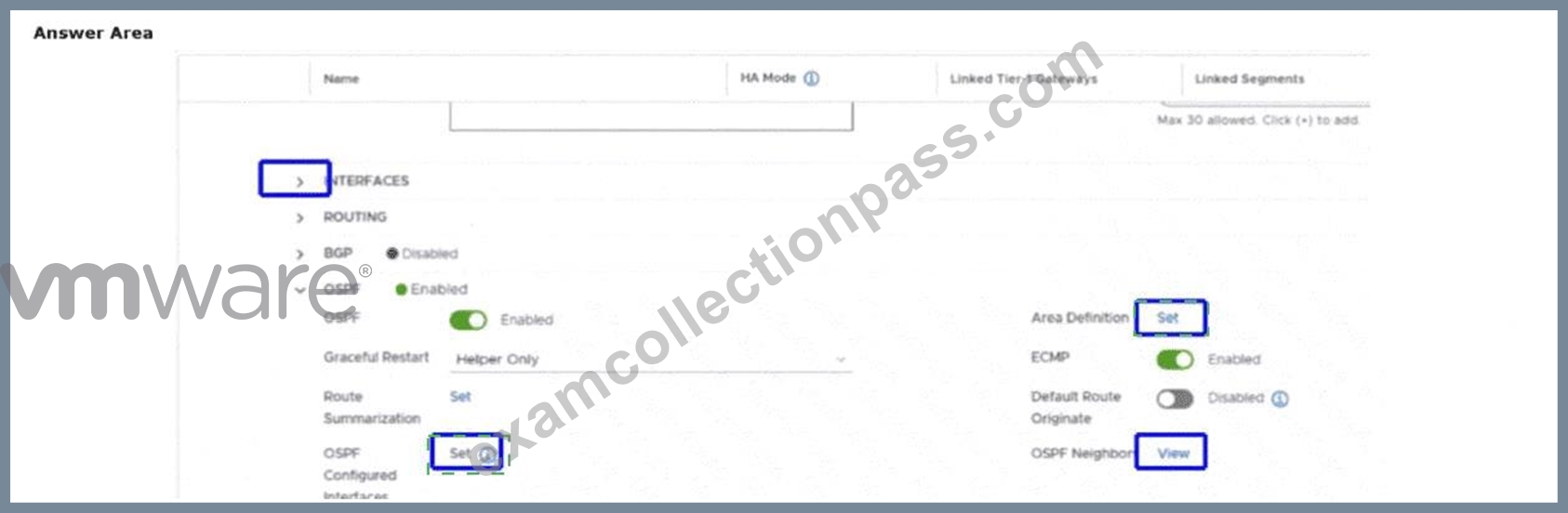
Explanation:
To enable OSPF on a Tier-0 Gateway within a VMware Cloud Foundation (VCF) or NSX environment, an administrator must define the areas where the gateway will participate and the specific interfaces it will use for peering.
Based on the NSX Manager configuration interface, the two required items to be configured are:
* Area Definition: This is necessary to define the OSPF area (e.g., Area 0) the Tier-0 gateway will participate in.
* OSPF Configured Interfaces: OSPF must be explicitly configured on the relevant uplink interfaces to establish neighbor relationships and exchange routing information with physical routers.
NEW QUESTION # 55
The network team has decided to use a single Edge Cluster to provide Tier-0 A/A Gateway routing and Tier-1 Gateway A/S services.
The active Tier-1 with a Gateway Firewall service is on EN2.
Which highlighted options will show the ECMP paths used by that Tier-1 GFW?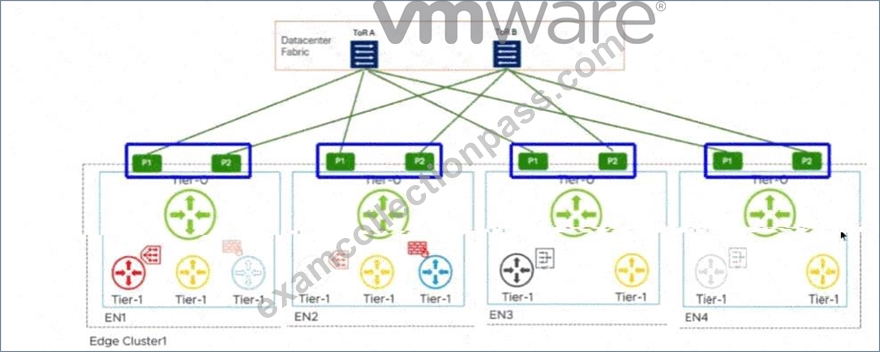
Answer:
Explanation: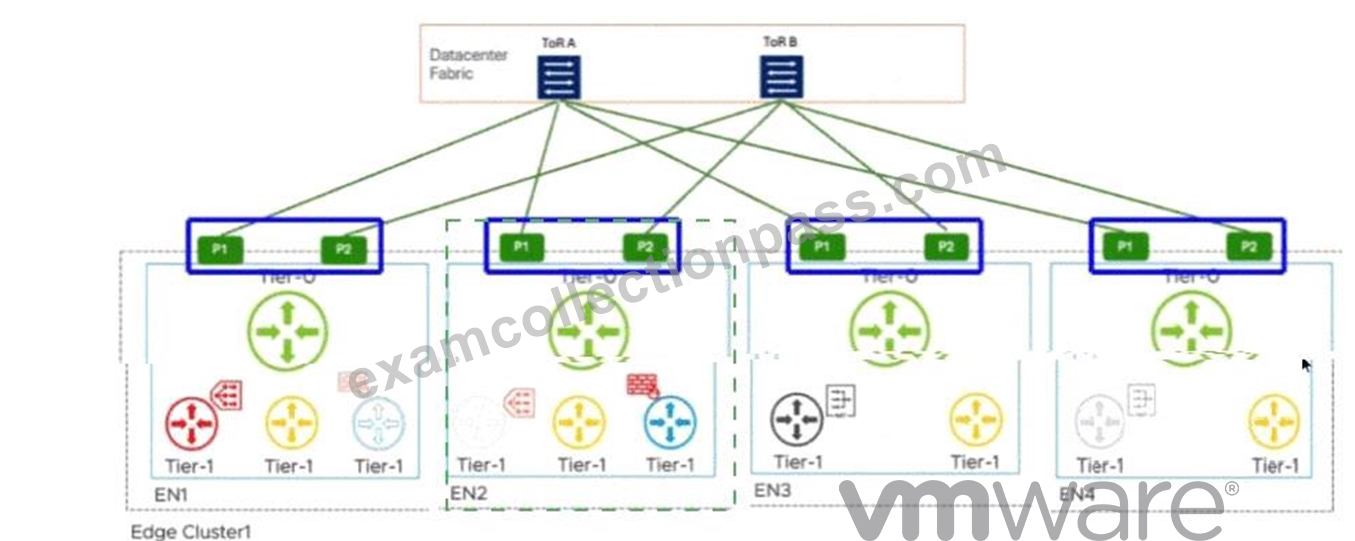
Explanation:
P1 and P2 interfaces on EN2
In aVMware Cloud Foundation (VCF)environment, the interaction between different tiers of logical gateways is governed by the placement ofService Routers (SR). When a Tier-1 Gateway is configured with stateful services, such as aGateway Firewall (GFW), it must operate inActive/Standby (A/S)mode. This ensures that session state is maintained on a single active node at any given time.
According to the provided diagram and VCF architectural guidelines, theActive Tier-1 SRis hosted onEdge Node 2 (EN2). In a multi-tier NSX design, the Tier-1 gateway is logically connected to the Tier-0 gateway via an internal transit segment (often referred to as the Router Link). While the Tier-0 gateway itself is running inActive/Active (A/A)mode across all nodes (EN1 through EN4) to provide high-bandwidth ECMP to the physical Top-of-Rack (ToR) switches, the Tier-1's path to the external world is constrained by its own current location.
Traffic originating from a workload segment attached to this Tier-1 will be processed by the GFW onEN2.
From there, the packet must exit to the physical network via the Tier-0 uplinks. Because the Tier-1 SR is localized to EN2, it will utilize the local Tier-0 instances and their corresponding physical uplinks located on that same node to avoid unnecessary inter-edge "East-West" hair-pinning over the Geneve overlay.
The highlighted optionsP1 and P2 on EN2represent the specific physical/logical uplink paths (VLAN- backed) that the Tier-1 GFW on EN2 will use to reachToR A and ToR B. Even though EN1, EN3, and EN4 also have active Tier-0 paths, the stateful nature of the Tier-1 on EN2 means its North-South traffic flow is anchored to the uplinks of its current host node. Therefore, to identify the ECMP paths actively utilized by that specific stateful Tier-1 service, the administrator must look at the uplink interfaces (P1/P2) associated with the node where that Tier-1 is active.
NEW QUESTION # 56
An administrator is tasked to configure NSX Federation between separate VMware Cloud Foundation (VCF) Fleets. Which requirement must all sites meet before being added to a Global Manager (GM) for NSX Federation?
- A. All Sites must use the same VTEP VLAN and IP pools.
- B. All sites must be managed by the same VCF instance.
- C. All sites must use identical Tier-0 gateway BGP autonomous system numbers.
- D. All sites must have the same NSX version and build.
Answer: D
NEW QUESTION # 57
An administrator is troubleshooting the packet flow of an incoming response to an ICMP Reply payload destined for 10.1.1.10 in the diagram.
The packet arrived at the Tier-0 SR at 172.16.215.100/29.
Which highlighted location identifies the next hop in the path to the destination?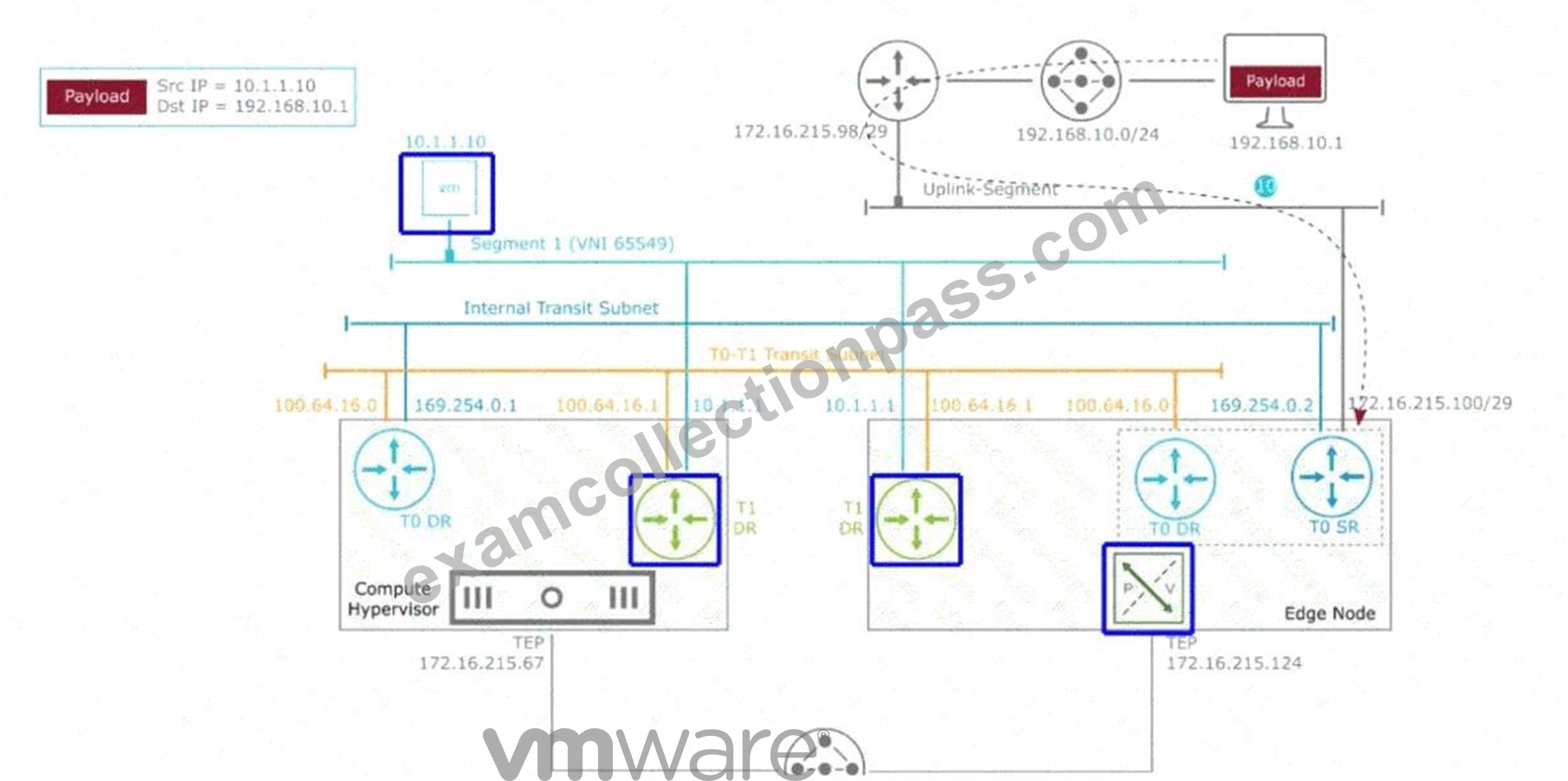
Answer:
Explanation: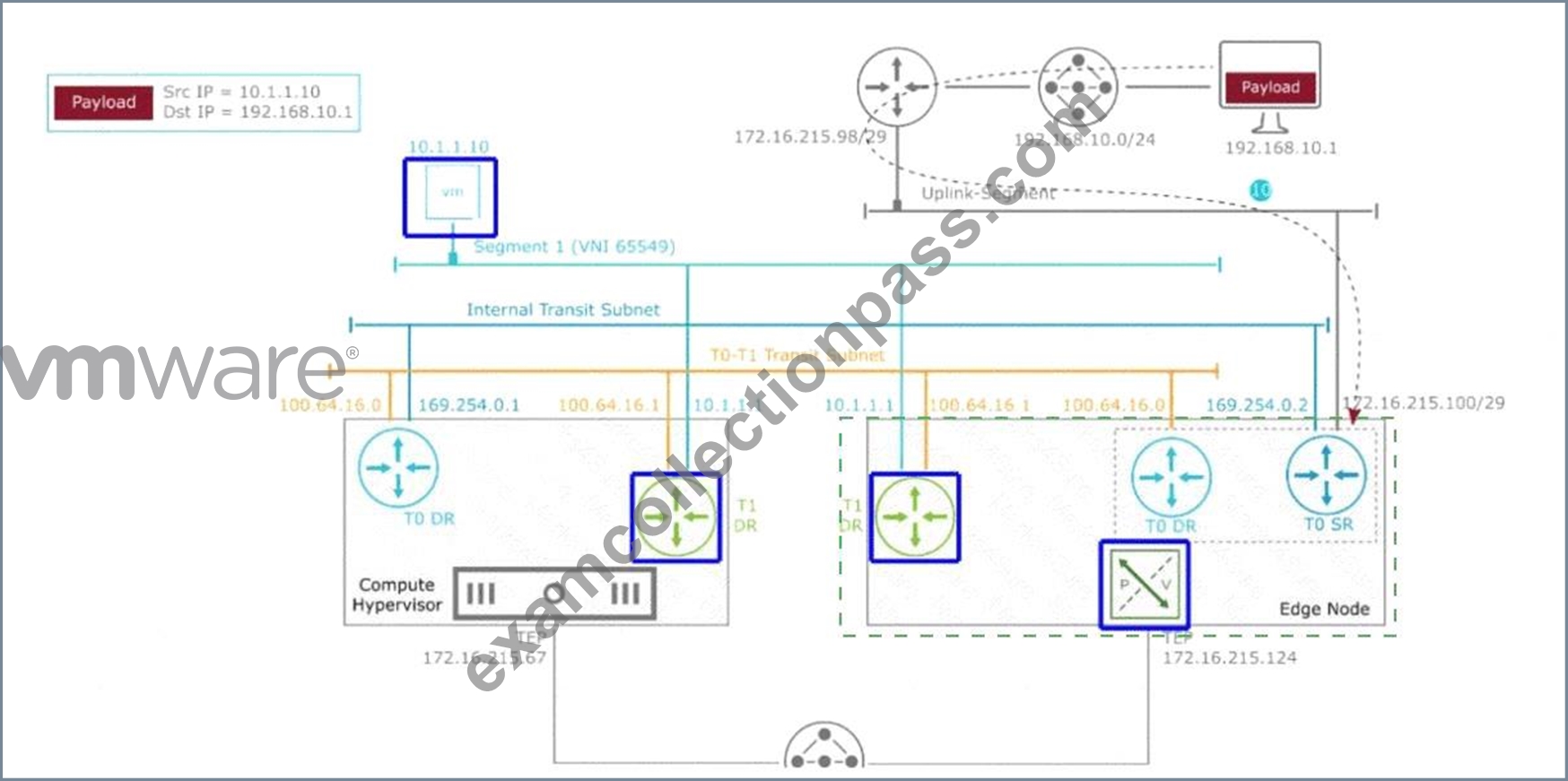
Explanation:
the administrator should click theTier-1 DR iconlocated within theEdge Node.
Comprehensive and Detailed 250 to 350 words of Explanation From VMware Cloud Foundation (VCF) documents:In aVMware Cloud Foundation (VCF)environment, North-South traffic flows through a hierarchical routing structure composed ofTier-0andTier-1 Gateways. Each gateway is further divided into a Distributed Router (DR)component, which runs as a kernel module on all Transport Nodes (ESXi and Edges), and aService Router (SR), which provides centralized services and resides on the Edge Nodes.
According to the packet walk logic for an incoming (North-to-South) packet, once the traffic arrives from the physical router at theTier-0 Service Router (SR)on the Edge Node, it must be routed toward the destination virtual machine (10.1.1.10). In a multi-tier NSX architecture, the Tier-0 SR identifies that the destination subnet belongs to a connectedTier-1 Gateway. The communication between the Tier-0 and Tier-1 gateways occurs over an internal transit subnet, often referred to as theRouter Link(in this diagram, represented by the
100.64.16.0/31 subnet).
The "Next Hop" for the packet currently residing at the Tier-0 SR on the Edge Node is theTier-1 Distributed Router (DR)instance located on that same Edge Node. This is because the Edge Node participates as a Transport Node in the overlay and maintains local instances of all Distributed Routers to ensure efficient path processing. After the packet is processed by the local Tier-1 DR on the Edge Node, it determines that the destination VM is residing on a remote host (Compute Hypervisor). Only then is the packet encapsulated in a Geneveheader and sent via theTunnel Endpoints (TEP)from the Edge Node (172.16.215.124) to the Compute Hypervisor (172.16.215.67). Therefore, the Tier-1 DR on the Edge Node is the immediate logical next step in the routing pipeline before any host-to-host encapsulation occurs.
NEW QUESTION # 58
An administrator is upgrading an existing VMware Cloud Foundation (VCF) environment. An NSX Edge Cluster is required to support north-south traffic for a workload domain. How would the administrator initiate the edge cluster deployment?
- A. From the vCenter Server Appliance Management Interface (VAMI).
- B. From the VCF Installer.
- C. From vCenter Network Connectivity wizard.
- D. Through VCF Operations Fleet Manager.
Answer: D
Explanation:
Comprehensive and Detailed 250 to 350 words of Explanation From VMware Cloud Foundation (VCF) documents:
In the architectural framework ofVMware Cloud Foundation (VCF) 9.0, the deployment and lifecycle management of infrastructure components have transitioned into a unified "Fleet Management" model. While previous versions of VCF (like 4.x or 5.x) relied exclusively on the SDDC Manager UI for the deployment of NSX Edge Clusters, VCF 9.0 centralizes these operations withinVCF Operations(integrated with the functionality formerly known as Aria Operations).
To initiate the deployment of an NSX Edge Cluster for a workload domain, the administrator uses theVCF Operations Fleet Manager. This interface provides a centralized orchestration point for the entire VCF
"fleet." When the deployment is triggered here, the system automates the selection of the underlying ESXi hosts, the configuration of the Virtual Distributed Switch (VDS) trunks, and the instantiation of the Edge VM appliances. This ensures that the deployment adheres strictly to theVMware Validated Solutions (VVS) guidelines and is consistent across all domains.
Option A is incorrect because theVCF Installer(Cloud Builder) is used for the initial "Day 0" bring-up of the Management Domain, not for post-deployment additions to workload domains. Option C and D are incorrect asvCenterand theVAMIdo not possess the multi-component awareness or the SDDC-level automation required to configure NSX Edge Clusters in a VCF context. By usingFleet Manager, VCF ensures that the new Edge cluster is automatically integrated into the SDDC Manager's inventory and lifecycle management workflows, maintaining a "single source of truth" for the entire private cloud environment.
NEW QUESTION # 59
......
We believe that every customer pays most attention to quality when he is shopping. Only high-quality goods can meet the needs of every customer better. And our 3V0-25.25 training quiz has such high quality, because its hit rate of test questions is extremely high. Perhaps you will find in the examination that a lot of questions you have seen many times in our 3V0-25.25 Real Exam. And you will find our 3V0-25.25 practice questions are so popular that a lot of our candidates have bought them.
Examinations 3V0-25.25 Actual Questions: https://www.examcollectionpass.com/VMware/3V0-25.25-practice-exam-dumps.html
- 3V0-25.25 New Dumps Book ↕ New 3V0-25.25 Exam Prep ???? 3V0-25.25 Test Simulator ???? Easily obtain free download of [ 3V0-25.25 ] by searching on ✔ www.exam4labs.com ️✔️ ????Pdf 3V0-25.25 Torrent
- Exam 3V0-25.25 Tests ???? Exam 3V0-25.25 Tests ???? Valid Exam 3V0-25.25 Registration ???? 「 www.pdfvce.com 」 is best website to obtain “ 3V0-25.25 ” for free download ????Latest 3V0-25.25 Test Report
- Pdf 3V0-25.25 Torrent ???? Valid 3V0-25.25 Vce Dumps ???? 3V0-25.25 Sample Exam ???? Search for ⏩ 3V0-25.25 ⏪ and download it for free immediately on ➡ www.vce4dumps.com ️⬅️ ⛳New 3V0-25.25 Exam Review
- 3V0-25.25 exam copyright - 3V0-25.25 guide torrent ???? The page for free download of ▛ 3V0-25.25 ▟ on ➥ www.pdfvce.com ???? will open immediately ????3V0-25.25 Study Materials Review
- 3V0-25.25 Quiz ???? 3V0-25.25 Lead2pass ???? 3V0-25.25 Reliable Cram Materials ???? Search on ➠ www.pdfdumps.com ???? for ⏩ 3V0-25.25 ⏪ to obtain exam materials for free download ????Pdf 3V0-25.25 Torrent
- Valid 3V0-25.25 Vce Dumps ???? New 3V0-25.25 Exam Review ⏮ 3V0-25.25 Sample Exam ℹ Easily obtain ➤ 3V0-25.25 ⮘ for free download through { www.pdfvce.com } ????3V0-25.25 Test Simulator
- Sure 3V0-25.25 Pass - High-Efficient Examinations 3V0-25.25 Actual Questions and Correct Reliable Advanced VMware Cloud Foundation 9.0 Networking Study Guide ???? Open [ www.dumpsquestion.com ] enter ➽ 3V0-25.25 ???? and obtain a free download ????New 3V0-25.25 Study Notes
- Sure 3V0-25.25 Pass: 2026 Realistic VMware Examinations Advanced VMware Cloud Foundation 9.0 Networking Actual Questions Pass Guaranteed ☁ Easily obtain free download of [ 3V0-25.25 ] by searching on ( www.pdfvce.com ) ????3V0-25.25 Lead2pass
- Cert 3V0-25.25 Exam ???? 3V0-25.25 Study Materials Review ???? 3V0-25.25 Reliable copyright Ppt ???? Immediately open ➡ www.dumpsquestion.com ️⬅️ and search for ⇛ 3V0-25.25 ⇚ to obtain a free download ????New 3V0-25.25 Exam Prep
- VMware 3V0-25.25 Dumps - Pass Exam and Get Career Benefits ???? Simply search for ☀ 3V0-25.25 ️☀️ for free download on 「 www.pdfvce.com 」 ????Valid 3V0-25.25 Vce Dumps
- Trustworthy VMware Sure 3V0-25.25 Pass With Interarctive Test Engine - Newest Examinations 3V0-25.25 Actual Questions ???? The page for free download of 「 3V0-25.25 」 on ▷ www.prep4away.com ◁ will open immediately ⛅Valid 3V0-25.25 Vce Dumps
- sashaakcm497133.gynoblog.com, liviaxmhu791758.blog4youth.com, annieyveo001497.dgbloggers.com, lokeshyogi.com, bookmarkswing.com, www.stes.tyc.edu.tw, monicajbsx337225.bloggazzo.com, xanderatsj845480.blogunteer.com, www.stes.tyc.edu.tw, mattiejiod642886.blogtov.com, Disposable vapes
BONUS!!! Download part of ExamcollectionPass 3V0-25.25 dumps for free: https://drive.google.com/open?id=1bn7AGxooe3Cpi98Twg79HJaXgXlSei8P
Report this wiki page